
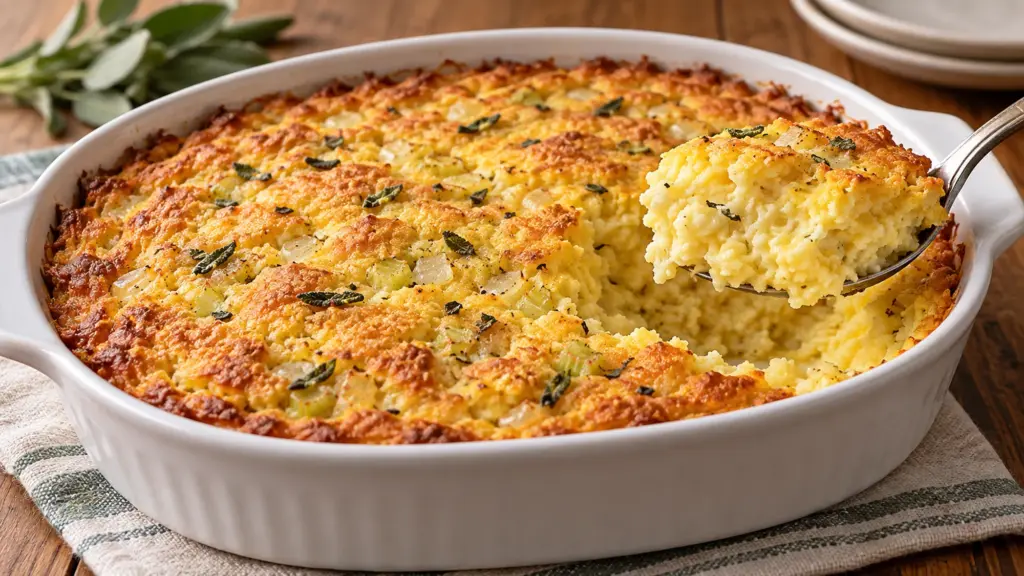
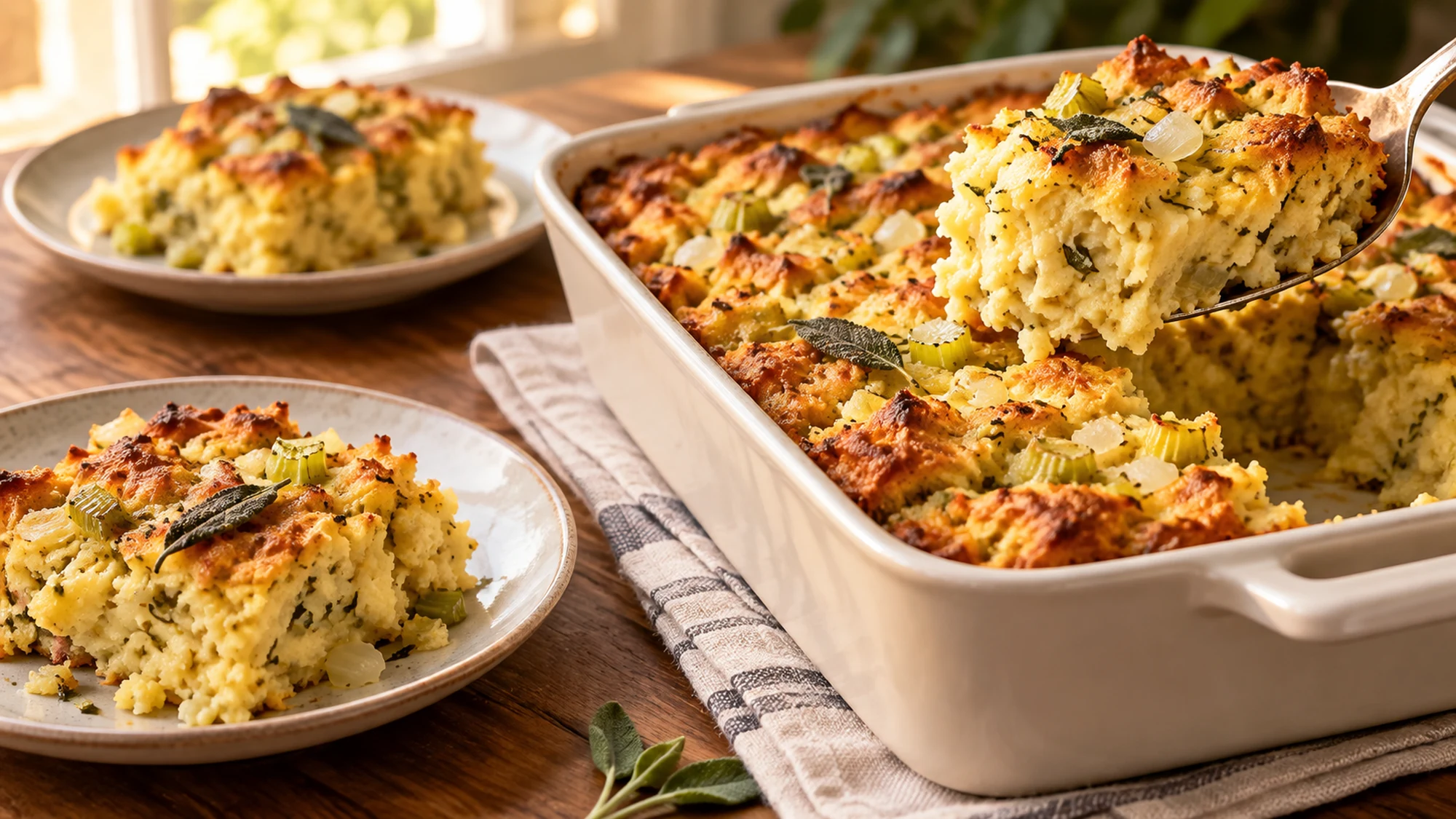
Spoonbread dressing brings the onion, celery, and sage of a holiday dressing into a soft cornmeal bake. Instead of cutting cubes or crumbling a loaf, you cook the cornmeal into a smooth base, fold in beaten eggs, and bake until the middle is set but still tender enough to scoop.
Cook the cornmeal fully before adding the eggs, then let the base cool until just warm so the eggs mix in smoothly rather than scrambling.
This version uses milk and vegetable broth, a measured amount of butter, and four eggs for a savory, gently puffed casserole. It contains no bread cubes or corn kernels. I’d choose fine cornmeal for the smoothest center; coarse polenta takes a different amount of time and liquid, which makes it a less predictable substitute.
Serving spoonbread dressing
Bring the dish to the table warm after a short rest, and use a broad serving spoon. The top may settle as it cools; that is expected for an egg-enriched cornmeal bake. It should hold a soft mound on the plate rather than slice into neat, dry squares.
Eight portions make sense when this is one of several sides. Serve it beside roasted poultry, cooked greens, and something tart such as cranberry sauce. If turkey is the main event, the blog’s measured turkey brine offers separate preparation guidance. Keep gravy in a jug rather than flooding the entire baking dish.
| Choice | What to expect |
|---|---|
| Alongside roast poultry | Serve a modest spoonful with vegetables and sauce on the side. |
| Vegetarian table | Use verified vegetarian broth and serve with a bean or lentil main. |
| Reheated portion | Cover while warming so the exposed surface does not dry out. |
Treat spoonbread dressing as a soft side dish, and let the rest of the plate provide the crisp edges and contrasting textures.
Variations and the cornmeal base
There are several approaches to this dish. Carla Hall’s published spoonbread dressing includes sweet corn and sugar. This formula follows a different direction, with extra savory vegetables, broth, no sweet corn, and no added sugar. Those differences matter when comparing texture and sweetness.
- For a different herb balance, replace half the sage with additional dried thyme rather than doubling all the herbs.
- For a chicken-broth version, use the same volume of low-sodium chicken broth; the dish will no longer be vegetarian.
- Avoid replacing fine cornmeal with instant cornbread mix, which contains other ingredients and will not behave like plain meal.
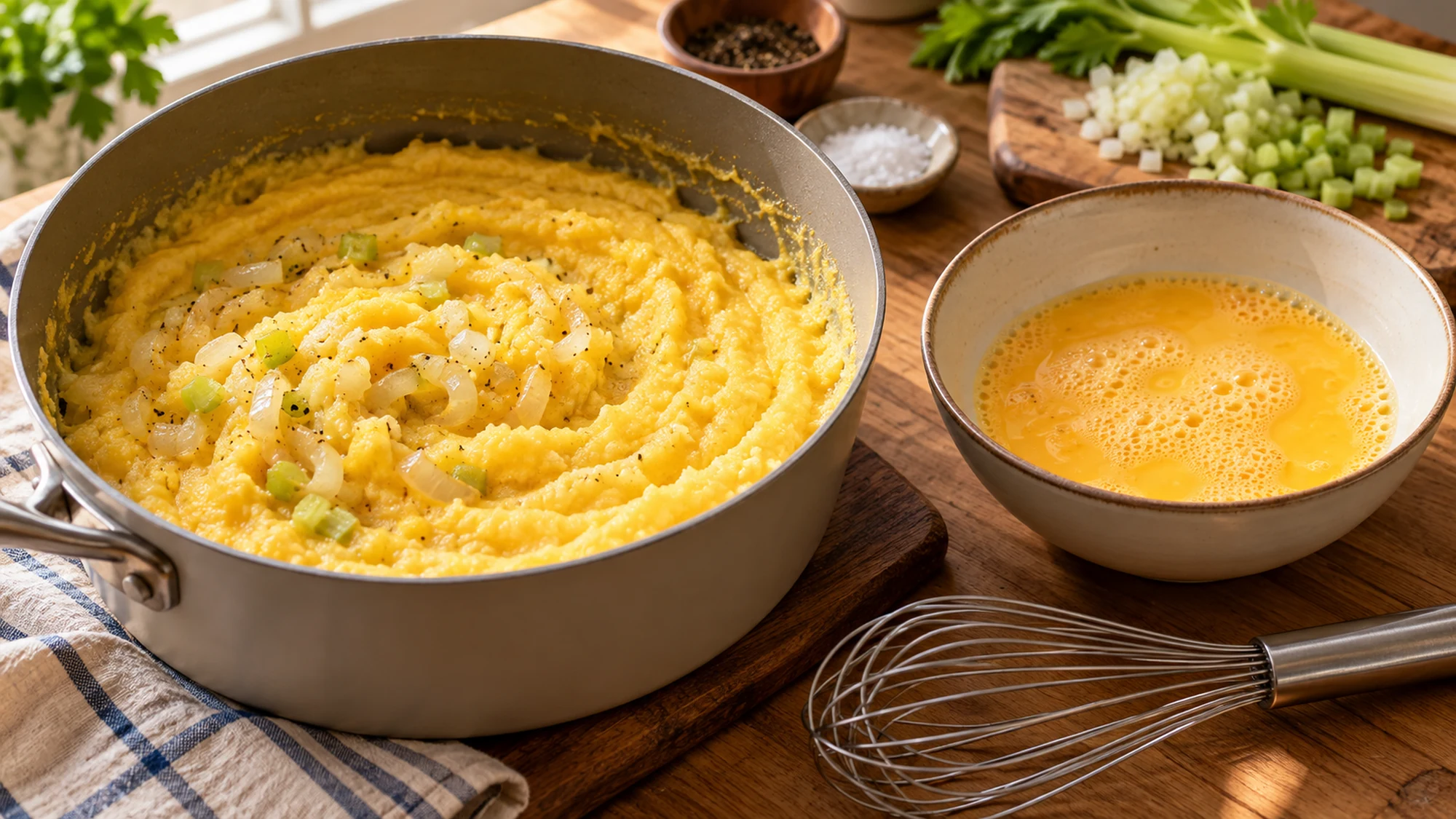
I’d soften the celery thoroughly before the cornmeal goes in. Tiny, tender pieces sit more comfortably in the custard than crunchy chunks. Whisk the meal into the hot liquid in a steady stream, scraping the pot’s corners as it thickens. Once the base is just warm, fold in the foamy eggs without beating out all their air.
A smooth, fully hydrated cornmeal base is the foundation; the oven sets the eggs rather than finishing a gritty meal.
Health benefits and serving estimates
One-eighth of the recipe is estimated at about 195 calories, with 8 grams of protein and 2 grams of fiber. The estimate includes the measured cornmeal, milk, butter, eggs, broth, and vegetables. It does not include gravy, poultry, or other sides, and different dairy products change the result.
Milk and eggs are included, so this dish does not suit those allergies without a separately developed recipe. Cornmeal itself is not the same thing as a gluten-free certification; anyone avoiding gluten should check the meal, broth, and seasonings as well as shared kitchen equipment.
- Bake this casserole until its center reaches 165°F/74°C, following the FoodSafety.gov casserole guidance; a golden surface alone does not establish doneness.
- Refrigerate promptly in shallow portions, use within three to four days, and reheat to 165°F/74°C, following Illinois Extension advice.
- The estimated cost is US$4.40 for the dish, about US$0.55 per portion, counting the ingredient amounts used rather than whole packages.
Keep the portion and accompanying gravy in view when considering nutrition; a soft vegetable-and-cornmeal side still contains measured butter, milk, and eggs.
Bottom Line
Spoonbread dressing offers familiar savory dressing flavors with a spoonable center. Soften the vegetables, hydrate the cornmeal, cool the base before adding eggs, and use the center temperature to guide the final bake.
Spoonbread Dressing Recipe

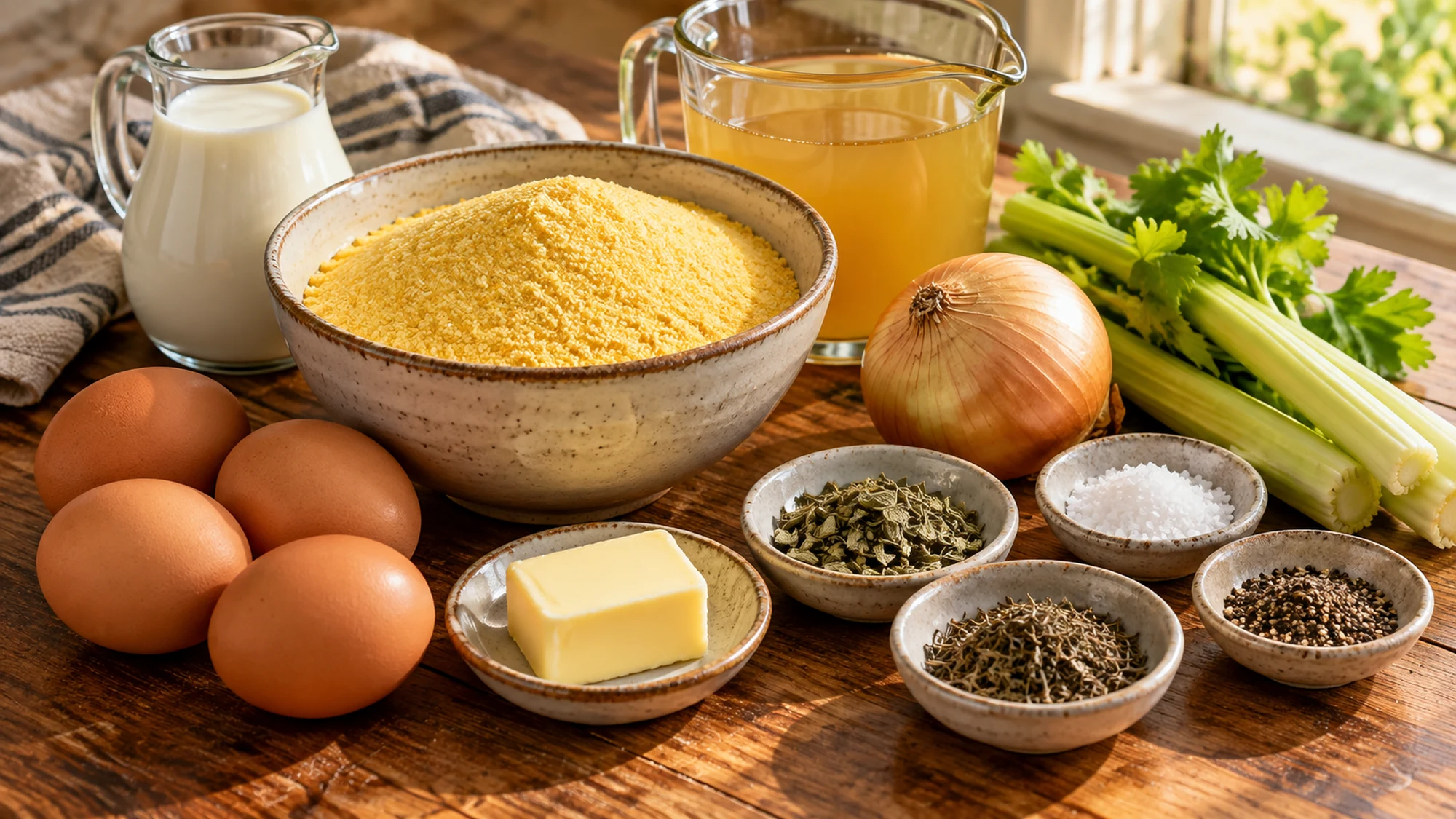
Ingredients
- 3 tbsp unsalted butter 42 g total, divided: 1 teaspoon for the dish, remainder for vegetables
- 150 g yellow onion finely diced
- 100 g celery finely diced
- 600 mL 2% milk
- 250 mL low-sodium vegetable broth
- 150 g fine yellow cornmeal plain cornmeal, not cornbread mix
- 1 tsp dried rubbed sage about 1 g
- 1/2 tsp dried thyme
- 1 tsp baking powder about 4 g
- 1/2 tsp fine salt about 3 g; adjust for broth
- 1/4 tsp black pepper
- 4 large eggs about 200 g without shells
Equipment
- 1 Shallow 2.5- to 3-quart baking dish
- 1 Large saucepan
- 1 Whisk or hand mixer
- 1 Food thermometer
Instructions
- Heat oven to 350°F/175°C. Grease a shallow 2.5- to 3-quart baking dish with 1 teaspoon of the measured butter. Finely dice onion and celery.
- Melt the remaining butter in a large saucepan over medium heat. Cook onion and celery for 7–9 minutes until fully tender. Add sage and thyme and stir for 30 seconds. Add milk and broth and bring just to a simmer.
- Whisk in the cornmeal in a slow, steady stream. Reduce the heat and cook, whisking and scraping the corners, for 5–8 minutes until thick and smooth. Stir in salt, pepper, and baking powder. Remove from heat and cool, stirring occasionally, until just warm rather than hot, about 10 minutes.
- Whisk the eggs in a clean bowl until pale and very foamy. Stir about one-third into the warm cornmeal base to loosen it, then gently fold in the remaining eggs in two additions. Transfer to the prepared dish.
- Bake for about 35–45 minutes until gently puffed and golden, with a set center that reaches 165°F/74°C on a food thermometer. Continue baking if needed; dish depth affects the time. Rest for 10 minutes and serve with a spoon. The top will settle somewhat as it cools.
Nutrition
Video
Notes
Tried this recipe?
Let us know how it turned out!Hi, I’m Emily Pocker! I share recipes and food guides here at Recipes360 to help you find everyday meal inspiration and feel more confident in the kitchen. My goal is to make cooking approachable, enjoyable, and full of flavor.