
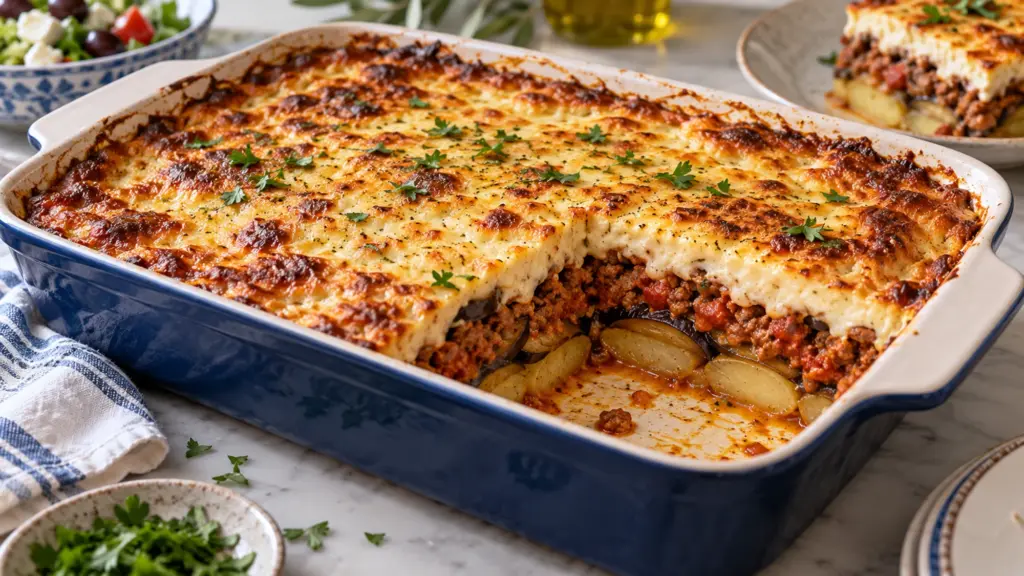
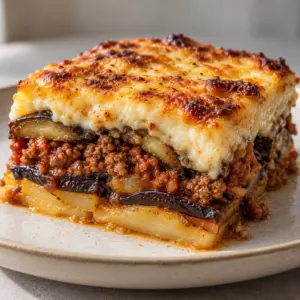
A golden topping can make moussaka look ready to cut the moment it leaves the oven. Give it a little patience instead. Beneath that creamy surface are roasted eggplant, thin potatoes, and cinnamon-scented beef sauce, and a short rest helps those soft layers hold a serving shape. This version roasts the vegetables and uses an egg-free béchamel.
For moussaka with distinct layers, roast the vegetables until tender, reduce the meat sauce until thick, and let the finished casserole rest before cutting. A browned top is only one cue; check the center’s temperature too.
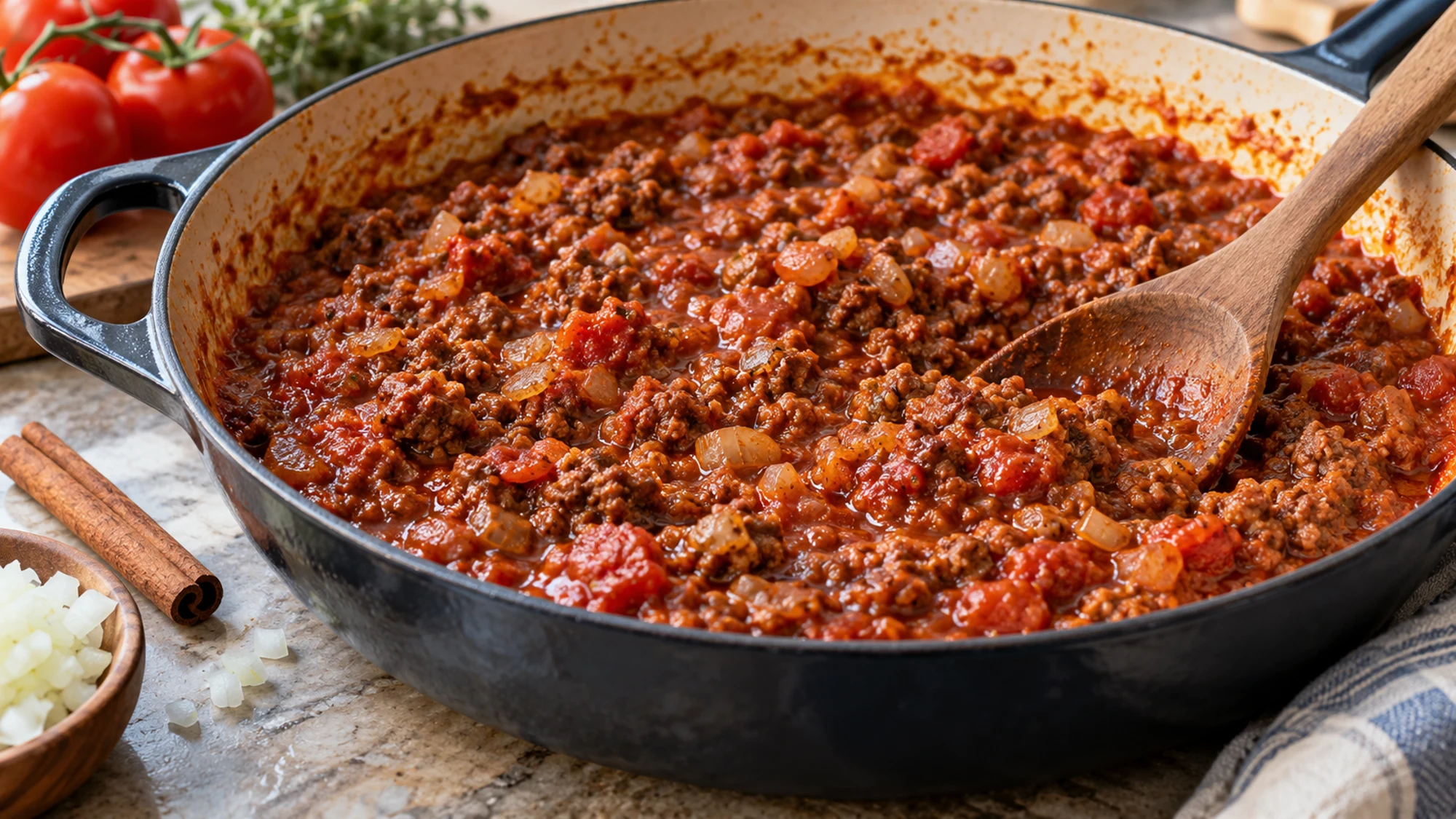
I’d save the most attention for moisture rather than perfect-looking layers. Eggplant that is still firm or sauce that runs across the skillet will not improve simply because it is hidden under béchamel. The separate components take some work, but you can prepare the sauce while the vegetables roast instead of standing over a pan of frying oil.
Serving Suggestions for Moussaka
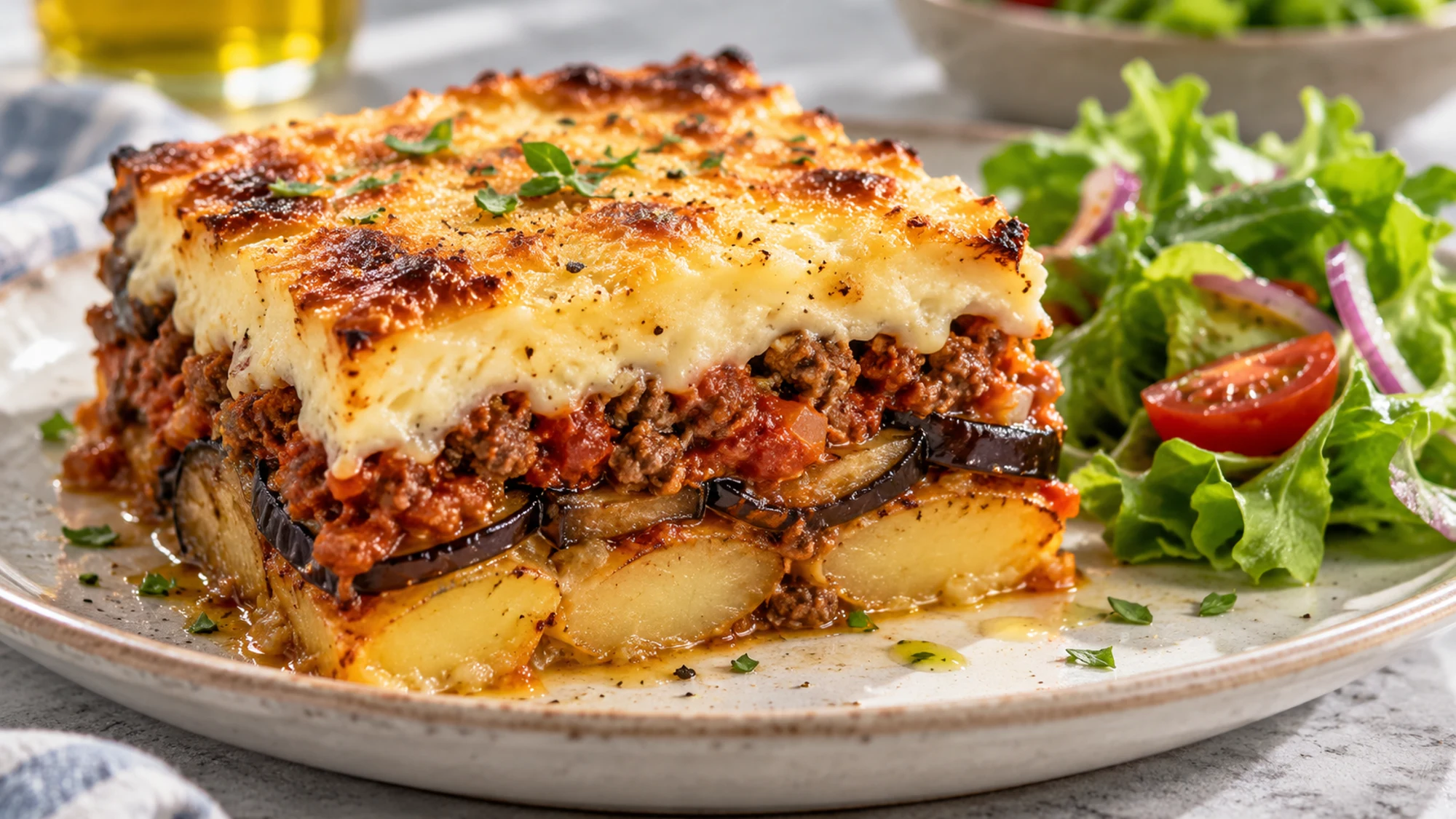
Use a broad spatula to lift each portion, reaching underneath the potato layer. The first piece may be a little untidy, which is hardly a dinner emergency. A crisp cucumber-and-tomato salad with lemon makes a useful contrast to the warm, soft casserole; keep the salad dressing light rather than adding another creamy sauce.
| On the plate | Why it helps |
|---|---|
| Simple green salad | Fresh leaves contrast with the soft eggplant and creamy topping. |
| Cucumber and tomato | A cool, juicy side balances the warm casserole. |
| A small piece of bread | Useful for the sauce left on the plate; optional because potatoes are already included. |
If you want bread alongside, this baguette recipe offers a crisp-crusted option. I’d keep the portion small and let the casserole do most of the work. Moussaka is substantial on its own; a second rich side is more likely to compete with it than improve the meal.
- Rest for about 30 minutes after baking so the layers settle while staying warm.
- Refrigerate portions within two hours in shallow covered containers, rather than waiting for a whole deep casserole to cool on the counter.
- Use refrigerated leftovers within three to four days, following safe cooling and storage guidance. Reheat portions to 165°F (74°C).
Give the casserole time to settle, lift it from the bottom layer, and put something crisp and fresh beside it.
Moussaka Variations
Ground beef makes a familiar, accessible filling here. Ground lamb can replace it for a stronger flavor; the fat level and nutrition will change. If using a fattier mince, spoon off excess rendered fat before adding the tomatoes. The sauce should remain moist enough to spread, without a visible puddle collecting at the edge.
- For a more pronounced spice note, increase cinnamon cautiously. It should sit behind the savory sauce rather than make it taste like a sweet filling.
- For extra herbs, add chopped parsley to the meat sauce after it has reduced. Keep watery additions out of the assembled layers.
- For a smaller meal, halve the ingredients and use a smaller baking dish that gives a similar depth. Begin checking earlier instead of assuming the same timing.
- For a vegetarian casserole, choose a separate lentil or mushroom formulation. Simply removing the beef changes the filling’s volume, moisture, and protein.
This version skips zucchini and the egg yolks often used in the topping. The Akis Petretzikis moussaka guide illustrates those additions in another formulation. Here a flour-and-butter roux thickens the milk sauce; it remains creamy and depends on resting for a cleaner slice.
Change the meat or seasoning deliberately, but keep the filling thick and the vegetables fully tender before assembling.
Health Benefits and the Whole Serving
Eggplant, potatoes, and tomatoes bring vegetables to the dish, while beef and milk contribute protein. Butter, oil, and cheese also belong in the picture. Roasting lets you measure the oil used on the vegetables; it does not turn a creamy casserole into a low-calorie food or guarantee a particular health outcome.
- The card estimates one-eighth of the casserole, including all measured oil and topping. Different beef fat levels and cheese brands change the figures.
- The standard recipe contains milk and wheat. An egg-free topping does not make it dairy-free or suitable for every allergy.
- Use a thermometer: FoodSafety.gov specifies 165°F (74°C) for casseroles. Appearance alone cannot establish a safe temperature.
Think in terms of a satisfying portion, a fresh side, and careful handling rather than giving the whole casserole a health label.
Bottom Line
Moussaka rewards three practical choices: tender roasted vegetables, a thick meat sauce, and a rest before serving. Keep the béchamel smooth, check the temperature at the center, and expect comfort-food layers rather than a perfectly rigid stack.
Moussaka Recipe

Ingredients
- 2 large eggplants 900 g total; trimmed and cut into 1/3-inch (8 mm) rounds
- 1 pound Yukon Gold potatoes 450 g; peeled and sliced 1/4 inch (6 mm) thick
- 3 tablespoons olive oil
- 1/2 teaspoon fine salt
- 1/2 teaspoon dried oregano
- 1 tablespoon olive oil
- 1 medium onion 150 g, finely chopped
- 2 cloves garlic minced
- 1 1/2 pounds 90% lean ground beef 680 g
- 2 tablespoons tomato paste 30 g
- 1 can crushed tomatoes 14–15 ounces, about 400 g
- 1/2 teaspoon ground cinnamon
- 1/2 teaspoon dried oregano
- 1/2 teaspoon fine salt
- 1/4 teaspoon black pepper
- 4 tablespoons unsalted butter 56 g
- 6 tablespoons all-purpose flour about 50 g
- 2 1/2 cups whole milk 600 ml, warmed
- 2 ounces finely grated Parmesan 60 g, divided
- 1/8 teaspoon ground nutmeg
- 1/4 teaspoon fine salt
- 2 tablespoons chopped parsley optional garnish
Equipment
- 1 9 x 13-inch baking dish
- 1 Two rimmed baking sheets
- 1 Large skillet
- 1 Saucepan
- 1 Whisk
- 1 Knife and cutting board
- 1 Food thermometer
- 1 Broad serving spatula
Instructions
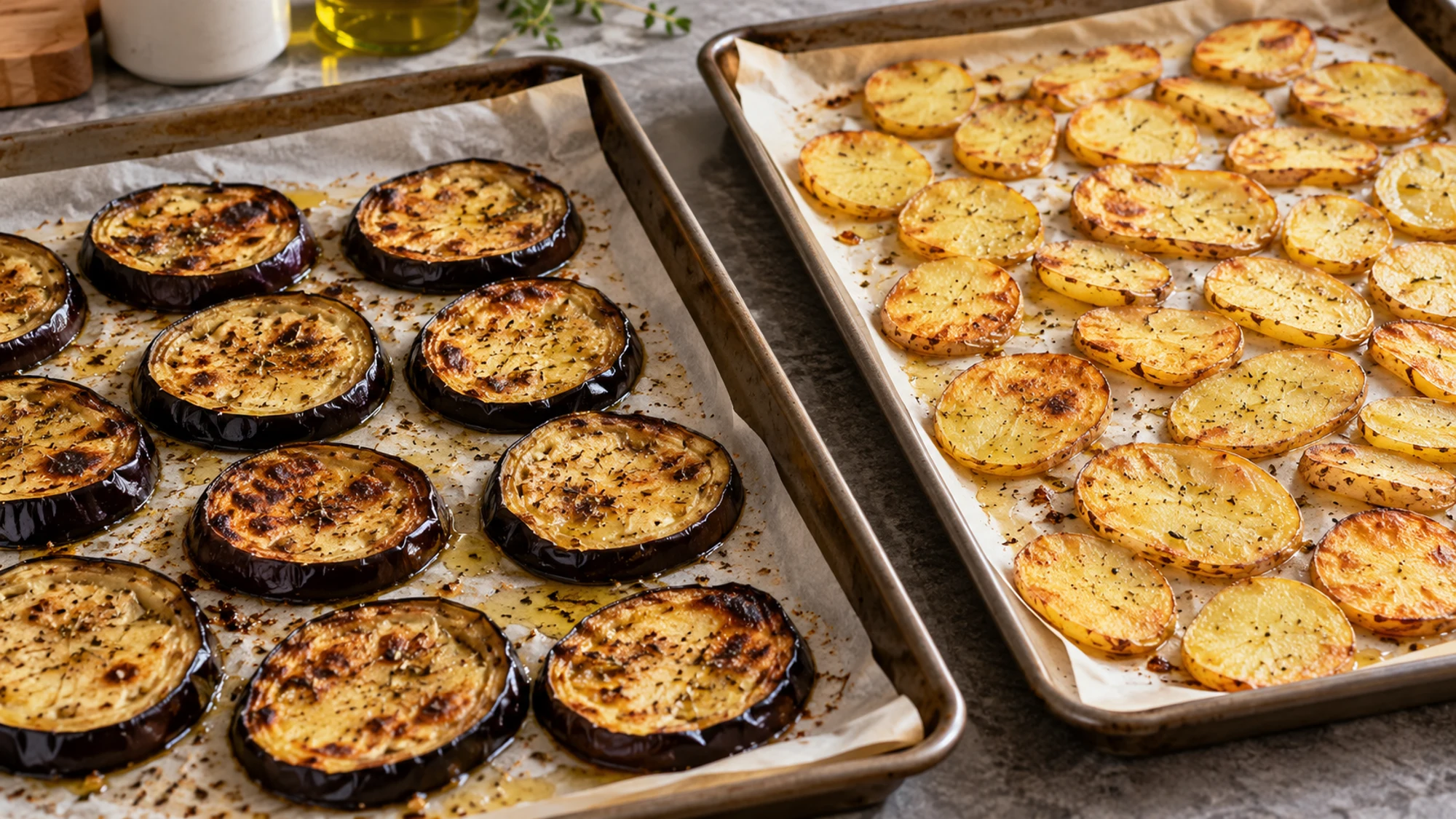
- Heat oven to 425°F (220°C). Line two rimmed sheets with parchment. Toss eggplant and potatoes with the 3 tablespoons oil, salt and oregano. Spread separately without crowding. Roast 30–35 minutes, turning after about 20 minutes, until the potatoes are tender and the eggplant is soft and browned. Use more time if needed.
- Meanwhile, heat 1 tablespoon oil in a large skillet over medium heat. Cook onion about 5 minutes until softened. Add garlic for 30 seconds, then beef. Break it into small pieces and cook thoroughly; ground beef should reach at least 160°F (71°C). Spoon off excess rendered fat if needed.
- Stir in tomato paste, crushed tomatoes, cinnamon, oregano, salt and pepper. Simmer uncovered 15–20 minutes, stirring, until thick enough that a spoon leaves a brief trail and no loose puddle forms. Add a splash of water only if it catches before thickening.
- Melt butter in a saucepan over medium-low heat. Whisk in flour and cook 1 minute without browning. Gradually whisk in warm milk, keeping the mixture smooth. Bring to gentle bubbles and cook 3–5 minutes, stirring, until it coats a spoon. Remove from heat; stir in 40 g Parmesan, nutmeg and salt.
- Reduce oven to 375°F (190°C). Lightly oil the baking dish using any oil remaining on the vegetable trays. Arrange potatoes across the base. Add half the eggplant, half the meat sauce, remaining eggplant and remaining meat sauce. Spread béchamel over the top and sprinkle with the remaining 20 g Parmesan.
- Bake 35–40 minutes, until the top is golden and the center reaches 165°F (74°C). If the top colors too quickly, cover loosely with foil. Rest about 30 minutes before cutting into 8 portions. Add optional parsley. Refrigerate leftovers within 2 hours in shallow covered containers and use within 3–4 days; reheat to 165°F (74°C).
Nutrition
Video
Notes
Tried this recipe?
Let us know how it turned out!Hi, I’m Emily Pocker! I share recipes and food guides here at Recipes360 to help you find everyday meal inspiration and feel more confident in the kitchen. My goal is to make cooking approachable, enjoyable, and full of flavor.