
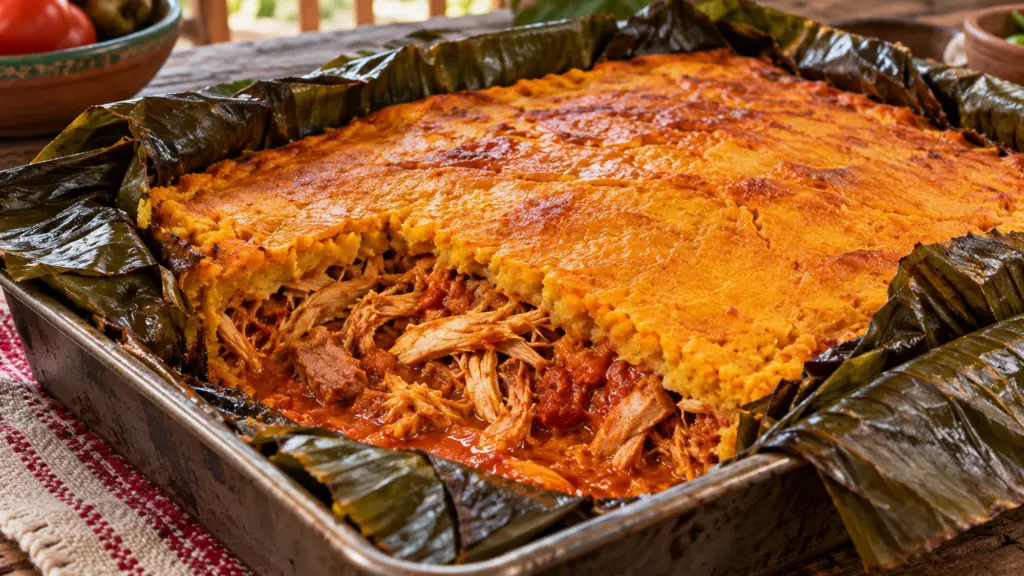
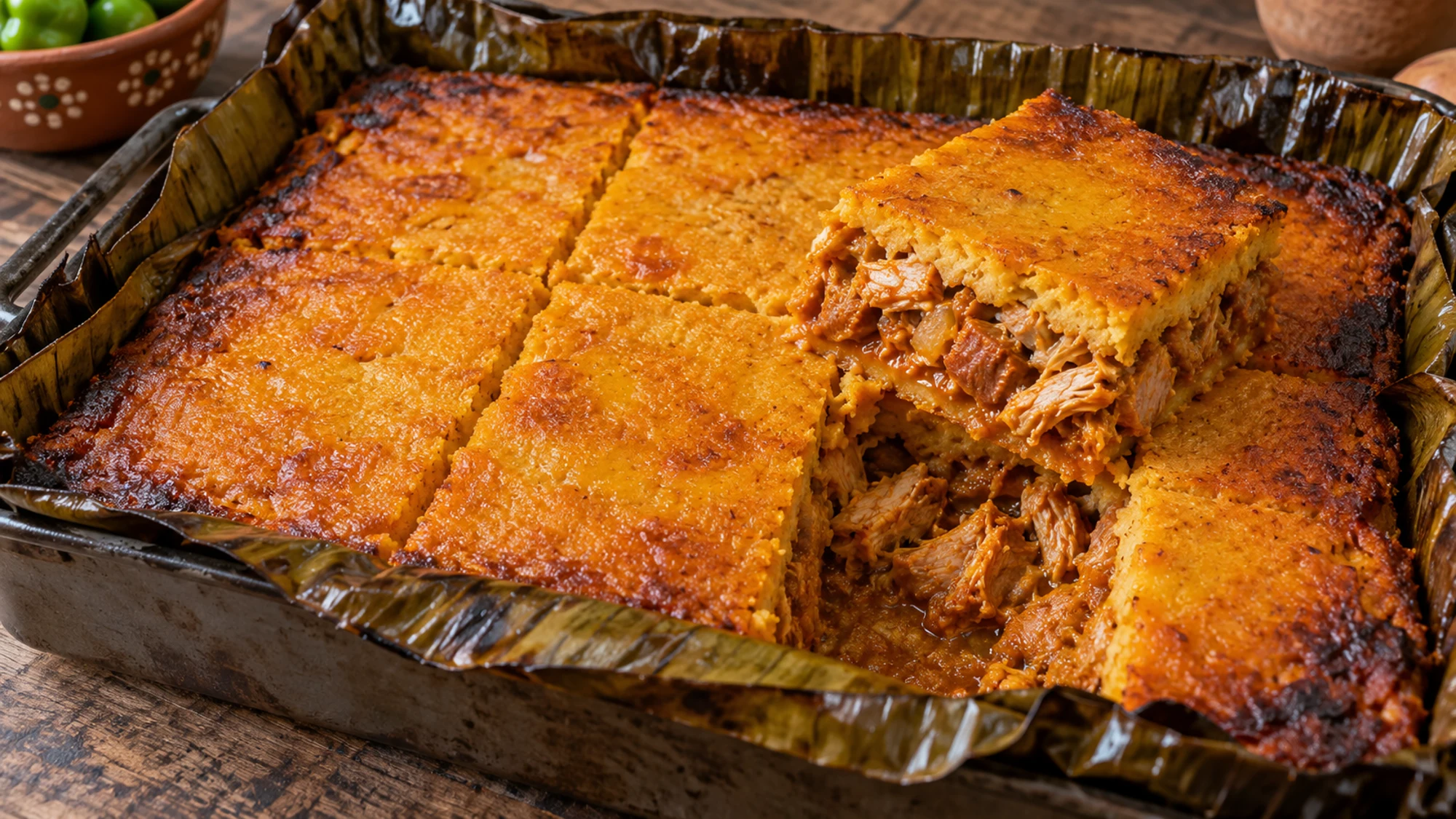
The moment a banana-leaf parcel opens, the corn and achiote aromas explain why this is more than an ordinary casserole. Mucbipollo is a substantial Yucatecan baked tamal: a corn-masa enclosure around a savory filling, traditionally associated with Hanal Pixán. This home-oven version uses cooked chicken and pork, a thick tomato-and-achiote sauce, and a rectangular pan that makes the assembly manageable.
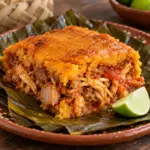
For sliceable mucbipollo, keep the masa soft but shapeable and thicken the filling sauce before assembling. Banana leaves wrap the pan; a covered bake cooks the masa, and a short rest helps the portions hold together.
Names and preparations vary, including mukbilpollo and pib. Yucatán Today’s local account describes the masa-thickened k’óol, banana-leaf wrapping and family variations. I would treat this recipe as an approachable oven adaptation, not as a replacement for a family’s traditional preparation or the flavor of an underground pib oven.
Serving suggestions for mucbipollo
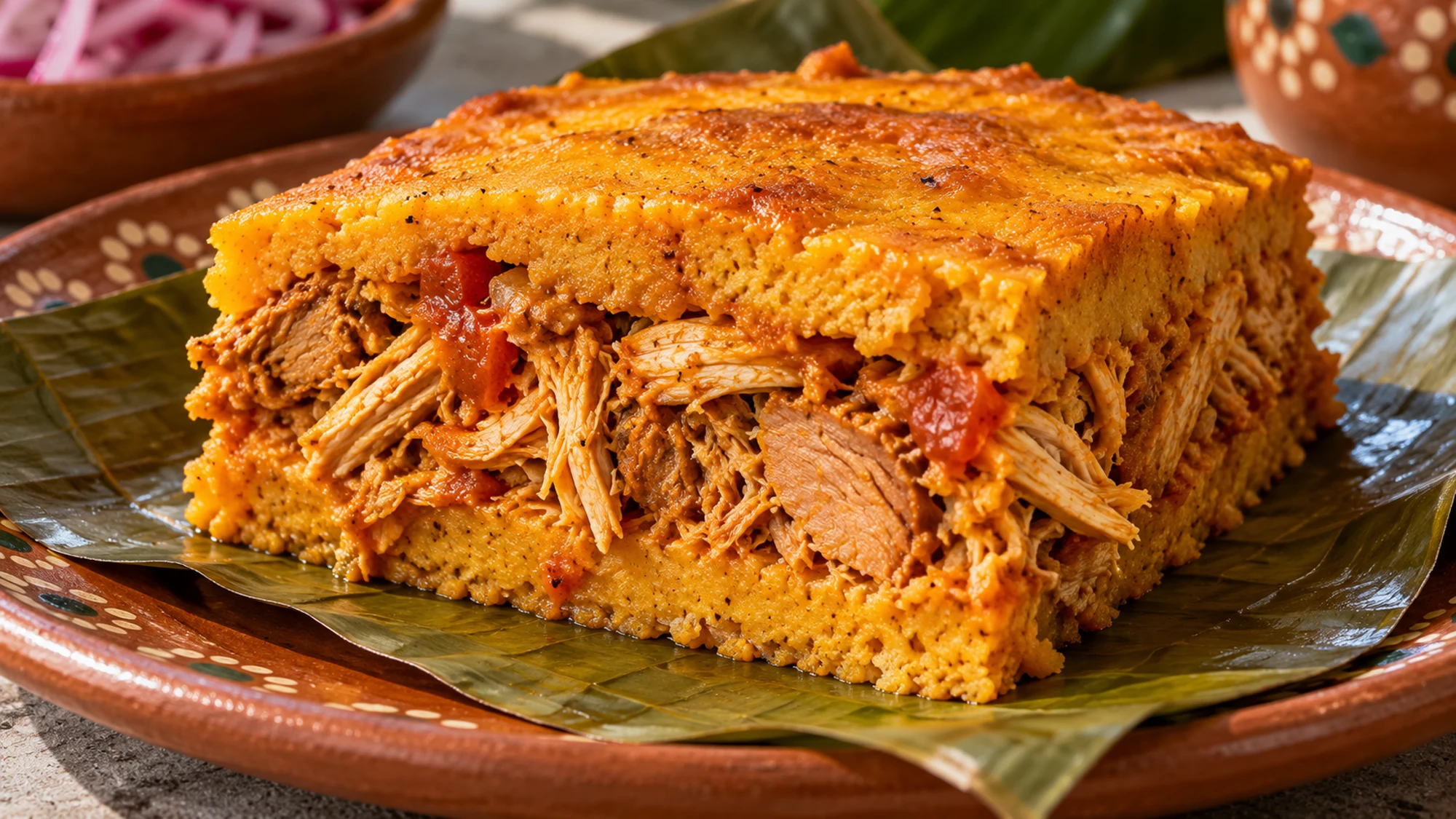
Give the pan a little breathing room after baking rather than cutting immediately. The filling is hot, and the masa needs time to settle around it. A broad spatula helps lift each square without dragging the bottom crust across the leaf. Peel away the wrapping before eating; the banana leaf is there for cooking and aroma, not for chewing.
- Serve with a crisp cabbage or cucumber salad, lime wedges and a small amount of pickled onion. The fresh crunch contrasts with the dense corn enclosure.
- Offer a habanero-lime condiment separately if you enjoy heat. Keep the base filling mild enough that diners can choose their own level, and wash hands carefully after handling chilies.
- Cut modest portions first. This recipe includes both a starch-rich crust and meat, so it does not need a large pile of rice beside it.
For another achiote-centered main dish, cochinita pibil takes a different route with citrus and tender pork. I would choose one as the centerpiece rather than crowding the table with several rich mains. A cold drink and something crunchy are usually the more useful additions.
Let the baked tamal rest, lift it with a wide spatula, and keep bright, crisp accompaniments simple.
Variations and ingredient choices
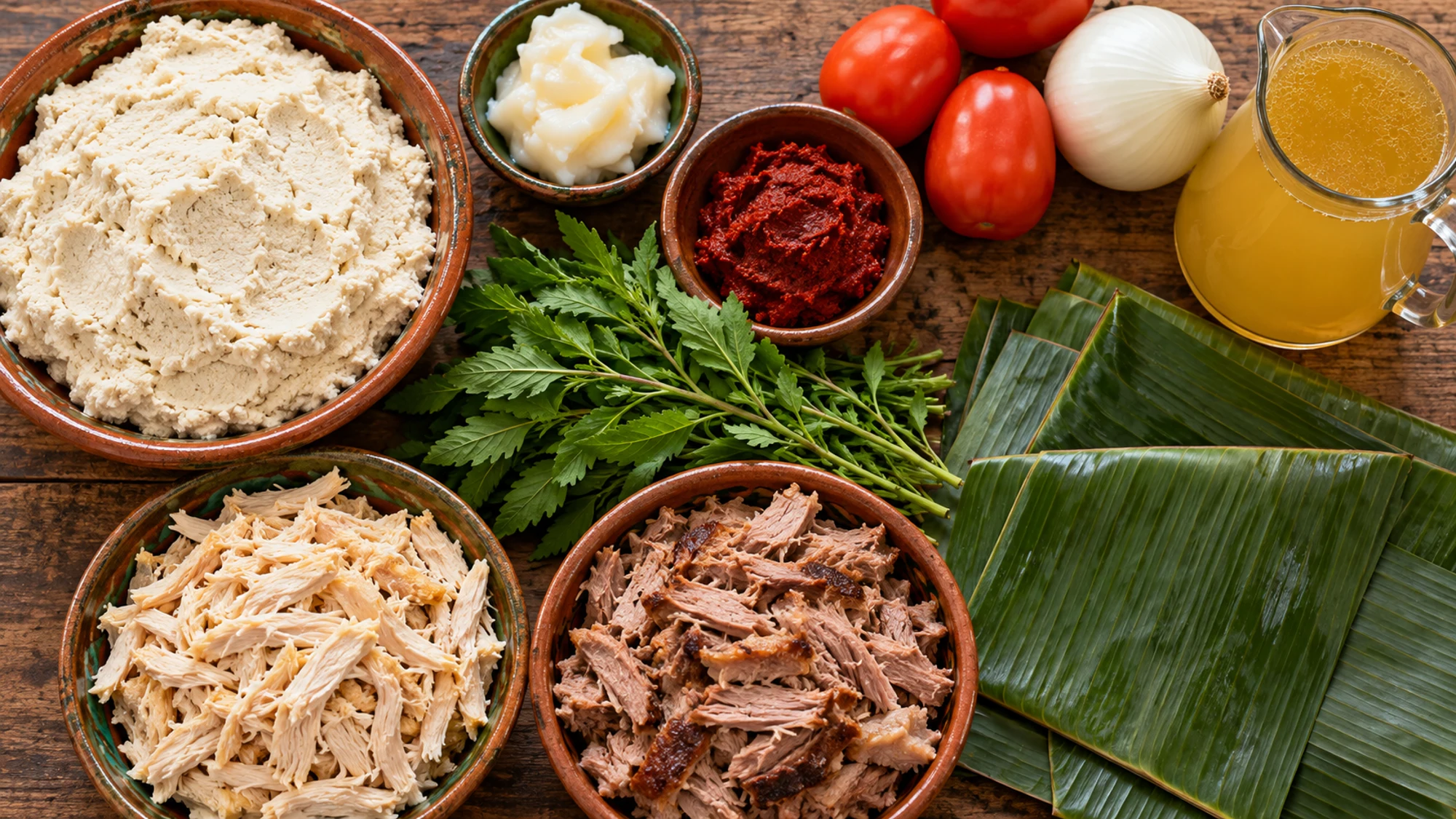
The card uses masa harina because it is easier to source consistently in many U.S. kitchens. It is not ordinary cornmeal: the corn has been treated for masa preparation. Hydrate it before adding the fat, and adjust by feel because brands differ. Fresh prepared masa can work, but it already contains water and cannot replace dry flour gram for gram.
| Ingredient choice | What changes | What to watch |
|---|---|---|
| Chicken and pork | Two textures in the filling | Use fully cooked, shredded meat. |
| Chicken only | A simpler variation | Replace the pork by cooked weight. |
| Fresh masa | Different starting hydration | Do not add the full dry-flour liquid amount. |
| No epazote available | Less characteristic herbal aroma | Omit rather than pretending another herb is identical. |
Some versions include x’pelón beans; this one does not. Achiote paste also varies in salt and seasoning, so check the package before adding the final salt. Banana leaves should be flexible enough to fold without splitting. I prefer overlapping pieces to one stubborn sheet: a small tear is easier to cover than to repair after the filling is inside.
Keep the defining corn, achiote and banana-leaf structure, and describe substitutions honestly rather than calling every variation traditional.
Nutrition and safe storage
Mucbipollo supplies protein from its meat filling and carbohydrate from the corn masa, but the lard makes it a rich dish. The estimated nutrition in the card describes one of ten portions, not a health promise. The calculation changes with meat cuts, broth, achiote and the actual amount of fat used; a salad can add variety without requiring a different recipe.
- Use cooked chicken and pork that have been refrigerated safely, not meat left on the counter while other preparations happen.
- After serving, divide leftovers into shallow containers and refrigerate within two hours, or within one hour above 90°F. CDC leftover guidance recommends using refrigerated leftovers within three to four days.
- Reheat portions to 165°F in the center, checked with a thermometer, following USDA reheating guidance. A browned edge does not prove the middle is hot.
Enjoy the rich corn-and-meat combination in a portion that suits the meal, and give leftovers the same attention as the first serving.
Bottom Line
Mucbipollo rewards careful assembly more than fancy equipment. A thick filling, pliable masa and overlapping banana leaves make a practical starting point for the home oven. Keep the cultural context visible, let the pan rest, and serve the slices while their corn aroma is still inviting.
Mucbipollo Recipe

Ingredients
- 500 g masa harina nixtamalized corn flour, not cornmeal
- 650 ml warm low-sodium chicken broth plus extra by the tablespoon if needed
- 140 g lard softened
- 20 g achiote paste
- 0.5 tsp salt adjust for broth and achiote
- 4 large banana-leaf pieces thawed if frozen, washed and dried; enough to line and cover pan
- 300 g fully cooked shredded chicken
- 250 g fully cooked shredded pork
- 300 g tomatoes finely chopped
- 150 g onion finely chopped
- 2 garlic cloves minced
- 10 g lard
- 20 g achiote paste
- 350 ml low-sodium chicken broth divided
- 30 g masa harina for thickening
- 4 g fresh epazote leaves optional, chopped
- 0.5 tsp salt or less, to taste
Equipment
- 9 x 13-inch baking pan
- Large mixing bowl
- Saucepan
- Foil
- Instant-read thermometer
- Wide spatula
Instructions
- Heat the oven to 400°F (200°C). Briefly dip stiff banana leaves in hot water until pliable, then drain and pat dry. Line the 9 × 13-inch pan with overlapping leaves, leaving enough overhang to fold over the top. Reserve a piece for the lid.
- Heat 10 g lard in a saucepan over medium heat. Soften onion for 5 minutes, then stir in garlic for 30 seconds. Add tomatoes and cook 5 minutes. Dissolve 20 g achiote paste in 250 ml broth and add it. Whisk 30 g masa harina with the remaining 100 ml broth; stir into the sauce and simmer 4–5 minutes until thick enough to coat a spoon without watery pooling. Fold in cooked chicken, cooked pork and optional epazote; season with up to ½ teaspoon salt. Remove from heat.
- Dissolve the remaining 20 g achiote paste in 650 ml warm broth. Stir into 500 g masa harina and leave for 10 minutes. Beat the softened 140 g lard until smooth, then work into the hydrated masa with up to ½ teaspoon salt. Knead until soft, cohesive and easily spreadable, adding extra broth a tablespoon at a time only if it cracks badly. It must hold its shape, not pour.
- Press about two-thirds of the masa across the lined pan base and up its sides in an even layer. Spoon in the thick filling. Flatten the remaining masa between two pieces of food wrap or parchment, remove the upper sheet, then invert the masa over the filling. Remove the other sheet and pinch the edges closed. Patch any holes with masa.
- Lay a banana-leaf piece over the top and fold the overhanging leaves inward. Cover the pan tightly with foil. Bake for 90 minutes. Check that the masa is firm rather than wet and the center reaches at least 165°F (74°C); if needed, re-cover and bake in 10-minute increments. For a slightly drier top, uncover the foil and upper leaves carefully and bake another 10 minutes. Watch escaping steam.
- Let stand 20 minutes before cutting into ten portions. Lift out with a wide spatula and remove banana leaves before eating. Refrigerate leftovers promptly in shallow containers and use within 3–4 days; reheat to 165°F (74°C).
Nutrition
Video
Notes
Tried this recipe?
Let us know how it turned out!Hi, I’m Emily Pocker! I share recipes and food guides here at Recipes360 to help you find everyday meal inspiration and feel more confident in the kitchen. My goal is to make cooking approachable, enjoyable, and full of flavor.